Mini Trees Is Learning to Slow Down As Her Music Career Picks Up Speed [Q&A]
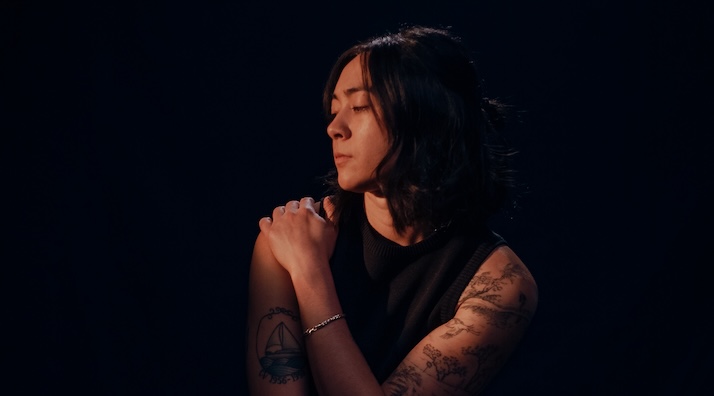
Photo by Seannie Bryan
Spinning, spiraling, accelerating towards burnout, and then easing, almost seamlessless, into stillness. Mini Trees, the solo project of LA-based songwriter Lexi Vega, writes in the rhythm she experiences time itself – always in motion or slowing down. Since her first release in 2018, her sound has lived somewhere between indie and alt-pop, what she jokingly calls “living room pop,” carrying the dreamy intimacy of bedroom pop with studio-polished clarity. Having experienced some major life changes recently, in her music career, personal life, and identity, she’s now taking steps forward to carve a path that feels closely aligned with her intuition and most importantly, places herself first.
We spoke with Mini Trees about her sophomore album Slow it Down (which she says is “the most important thing” she’s ever created), the artists who’ve shaped her sound, and rituals behind her creative process. The conversation drifted through the songwriter’s Japanese and Cuban heritage, the human search for identity, and discovering her queerness over the years. All the while, she strolled through the foothills of Pasadena – a neighborhood that has recently become a sanctuary for her ever since living on her own, where solitude has shifted from uneasy absence into a place she can return to, a state of grounding.
OnesToWatch: How did Mini Trees come to be?
Ever since I was a kid, I was always playing music in bands, but I hadn't really ever thought to write my own music or have an artist project until around 2018. The bands that I was playing in actively around L.A. were on hiatus so I was itching to do something and took the opportunity to start trying to write. Because of the friendships and connections I'd already made through playing in the L.A. scene, like my friend Jon, who's now been my producer since the very first song, I started sending him demos, and sussing out if I wanted to go in and record them. And so we did a first song together just for fun. I think that lit a fire. So I quickly thought of a band name with not really any meaning behind it, and started putting stuff out.
What inspired the name for the project?
I had some other band name ideas that were a bit more symbolic of my Japanese heritage, but a lot of them were already taken. I collect mini things, and I touch on this in my OnesToWatch video, it's kind of this inside joke. The trees part was kind of random.
Do you own any mini trees?
I do have two now. They were both gifts. One is kind of a Bonsai tree – actually, I don't know the specific species of tree it is, but I do have a couple in my house which makes me happy.
You released your sophomore album, Slow It Down, in November which I've seen described as your most vulnerable album to date. In a recent interview, you mentioned it's a record where you “unknowingly wrote [yourself] out of a life that [you] couldn't live anymore.” Can you elaborate?
For me, songwriting has always been a way to channel and process scary fears and anxieties, almost like a journal. I lowkey forget that people will end up hearing it. But a lot of the writing process for this album, I was writing about things that I hadn't fully come to terms with in my own life yet. It was sort of just “what if this were to occur?” What if this partnership, this marriage that I've been through a long time, what if this were to end? And I remember even thinking at the time, “it's kind of a weird thought experiment. Why would someone do that?” I even had friends who were checking in, like, “Hey, you good? What is this song about?” And I was like, “I don't know what you mean. I'm just writing my music, you know?” For me, it was a several years-long process of coming out fully. I have been aware of my queerness since college, but not fully understanding who I was, I married my college sweetheart, who, thankfully, is still a close friend of mine. But over the years, I realized that I was gay. It just took several years of figuring that out, and honestly, writing this album is kind of what pushed me into that full realization. So, in that way, it's incredibly vulnerable and the most important thing for me, personally, that I've ever created.
I know there were also some recent changes with leaving management and choosing to go forward independently.
Yeah, definitely. I was lucky to hit the ground running right out of quarantine with the label I was with, the management team I was with. We hit it really hard, and just over the last several years, it kind of felt like we'd stalled out. I was experiencing a good amount of burnout, and I think we had seen everything through that we were able to do together. I had this album that I wanted to write, and there were just some differences in opinions of how resources and time should be spent, whether it's constantly being on the road, supporting other bands, trying to grow the project that way versus what I was leaning towards, which was I needed to get in the studio and write this album. And so, we parted ways, and it kind of gave me a chance to realize I could do it with or without a team. Music for me is a compulsion. Like, I kind of have to do this. There's no real version of myself that isn't creating music or playing music. And thankfully, I have such an amazing community and group of friends that we all just got really scrappy with it and made it happen. So, yeah, I was super proud of what we pulled off together.
On Instagram, you shared that the song “Close” is about the weird lonely feeling of chasing a dream that always feels out of reach, and now you realize that that wasn't the point all along. What was the moment that helped you come to that realization?
Coming out of the phase of career burnout, when I parted ways with my previous team and decided I'm just gonna keep going forward. I would guess most artists dream about being able to do this full time, make this their career, actually get it to a point where you can pay your bills and all of that. Of course, that would be incredible, but I think I reached a point where I realized, for me, it's less about needing that to feel fulfilled, and more about continuing to put a lot of energy and love into this project, and continuing to create, share music, and that that is in and of itself, really, really fulfilling for me and allowed me to let go of a lot of the pressure that I felt of not needing to keep seeing certain metrics grow. I feel like I had to kind of just reach a point where I had to really appreciate and love the things that got me into music in the first place, and the reason I was so drawn to it – and that's writing, but also touring and playing shows, and getting to play with my best friends, and make music with my best friends,.
Sort of how it’s about the journey and not the destination.
That's true. Like most things, honestly.
I’m sure a lot of artists have had to come head on with that at a certain point in their career.
Yeah I mean, it's tough. It's like every year it seems like it's getting harder and harder for people to go on tour or make any kind of money off of their music. And yeah, it's just not the easiest industry, so, kind of have to revisit why we’re needed.
I find it interesting that your first album, Always in Motion, speaks to time while Slow it Down, feels in a way like a response to that feeling. In Slow it Down, we also get a lot of that spinning, spiraling imagery. Was that an intentional move on your end?
Yeah, that's a great shout. I'm a little bit of a broken record and like to sing about a lot of the same themes. Actually, my girlfriend teases me because of how many times I use those exact words across so many songs. And I want to say that it's an intentional choice, and part of this big concept, but honestly, it's less that and more of those just tend to be consistent things in my songwriting. Always in Motion was my first album, right after getting signed. It was really when this project felt real, like, okay, we're actually doing this. There was so much energy and momentum. There was also just this pressure of, “I'm running out of time. I have to do this as quickly as possible.” This sense of urgency, these opportunities might fall away. That's kind of what led to the career burnout, saying yes to everything. I think Slow it Down is a moment of, you can't really keep going like this. You have to face it.
You're planning to release the deluxe version of Slow It Down this year. Can you tell us a bit more about the decision to expand the album, and what listeners can expect to hear?
We're doing some reimagined versions of songs from other artists. I'm really, really excited about that because it's people who are friends, or artists who I really look up to. That'll span more remix versions, or others will be covers, but to be honest with you, I haven't heard them yet. They're in progress right now. So, I'm personally so excited. And I've been writing some additional songs that we’ll be putting out this year, and we've got some live versions as well.
What journey do you hope that the deluxe version of Slow it Down takes listeners on?
I hope for those who are already familiar with the record, that it's kind of a chance to hear the songs in a different light, which is sort of like, duh. But I guess what I mean is maybe lyrically. So the first one we're gonna put out is an acoustic version of my song, “Sludge” and on the album, that's a very noisy, rock song and for me, feels like one of the heaviest songs on the album but it's kind of masked behind big guitars and loud cymbals and belting. Whereas the acoustic version, it's slower, strumming acoustic guitars, piano, and it lets the lyrics land in a very different way. So I think that’s something that I really enjoy about hearing different versions of songs that I love or getting to explore that for my stuff. I think it lets the lyrics, or the meaning of the song, or the message of the song be heard in a different way.
Are there any other ways the idea of slowing down sonically shows up in the album?
We literally slowed the tempos of the acoustic songs. I wanted to do some acoustic versions, really stripping back the instrumentation on those songs, and then once we started working on them, they didn't feel right at the original tempo, so we slowed them down. But in regards to the others, it's a pretty steady upbeat record. The final track, the title track, is the core of it. I did intentionally want that to be the last thing that you hear before it ends, and that is a very stripped back, strutting on a clean tone electric guitar, basically, just my vocal for most of the song until the final chorus So I think that was a pretty intentional choice to leave that one very raw because the lyrics of that song capture the entire record in a way.
You wrapped up your first year of headline tours this winter, right?
Yeah, last year was the first time we ever hit the road to play any headline shows outside of LA.
Awesome. How did that feel?
It was incredible because I don't think I had any idea who would come. You just can't really tell, based on Spotify or Apple Music stats if those people will actually buy a ticket. You can't really tell when you're supporting other artists who actually came to see me or who would come back to see me. So you just have to get out there and try it. It started with a few shows that we threw together in January surrounding a festival we played in Boston called Something in the Way Fest. And that New York show that we played sold out. And so that was a huge trip to me that we could go play a show in New York City and sell it out. So that was like, okay, we gotta do more. We played Schubas Tavern in Chicago, and I think it was the previous year we had played there with Eliza McLamb, opening for her, and that was a really awesome sold out show. We returned to Schubas in December of last year for our show, and it sold out. And I was just, like, this is crazy to me. I had a big surreal moment realizing that.
Speaking of support tours, you've toured with so many cool artists, like Julien Baker, Yumi Zouma, Death Cab for Cutie, and more. What's a moment that sticks out to you from these experiences?
I have such good things to say about all of them. I feel really lucky. I've never had a nightmare tour experience. They've all been so generous and Julien, in particular, she is just so welcoming. She grinded for years and has worked so hard that she's one of those people who hasn't forgotten what it's like to be starting out. I always just remember how her and her entire band were – it was our first tour out of COVID – just really, really wonderful people. And we actually rode on the bus with them, 'cause we were just a two piece. And the fact that they opened up bunks on their bus to bring us along, that is such a generous thing to do. So she really showed me the ropes in that way, and it was such a cool thing to get to do early on.
I love that on social media and YouTube, you post live sessions of you playing your music. What is the importance of playing these live sessions?
It’s honestly because my band members are, like, so good, I want that to be recorded forever. In the studio, it's mostly just Jon, my producer, and I. Sometimes we'll bring in another musician to play on it, but for the most part, it's the two of us tracking everything which is fun, but I just feel the live band and each of the styles that each person brings, it's just a different version of it. And, initially, I had just assembled a band to open for Julien Baker, and it was only gonna be one show, and we played that show, and I was, like, this is the best the band has ever felt. I don't want it to just be one show. We should actually go and record this, and film it and put it out. I think that it really resonated with fans. One of them went pretty viral on Instagram and YouTube and it was cool to see, because as far as viral moments go, I'm really glad it was just a simple music video of us playing a song.
Something else that is really cool is that you break down your creative process in videos as well. And I'm curious, how has your creative process changed from when you first started releasing music in 2018 to now?
I definitely have gotten a lot more in the weeds on production for when I'm in the writing process. I still really value working with Jon, or producers like Jon, but I've started writing more parts and experimenting with different sounds, seeing the production through a little bit more in the writing phase instead of what I used to do which was the absolute bare minimum of a track just to get the point across. I was never really a voice memo person, but I think the demos I'd bring in before were just super, super bare bones. Whereas now, I think I have a little bit more of a creative vision early on. And it's great 'cause working with Jon for so long, he's always understood the creative vision, and so on the studio side, things haven't changed too much, but I just feel more confident about what I'm bringing in.
I read you're a sucker for layers and clustery harmonies and obviously, this is something that we hear in your music as well. Can you expand on that?
Yes, I love that. Imogen Heap, Japanese House, Bon Iver, any Justin Vernon project, you hear a lot of those really sad, melodic, clustery kinds of harmony stacks, or chords. I've always been drawn to that as a listener, and it just inevitably started to inform the music that I was writing. It came about with Jon and I tracking a lot of background vocals in the studio, and viewing them as an additional instrument, as if you were playing a synth pad, playing with background vocal melodies that are not just your typical third or fifth harmony, but really building it out. It tends to bring the song to a whole new place, and now it's part of the Mini Trees sound.
Both of your parents worked in the music industry. Your mom was part of a Japanese pop jazz fusion group – that’s so cool.
I know!
Your father was a Cuban born session drummer. Do you feel their styles influenced yours in any way?
I think so. Both parents, my dad, who passed away when I was a kid, but had a very prolific career, played a lot of jazz, played a lot of R&B and pop, and he was always known for just having the most incredible pockets, and sense of time and rhythm. And my mom, she raised me on music, like, Chaka Khan, and Aretha Franklin, and a lot of funk, a lot of music that had such a heavy drum and bass groove, and dance elements. I was always drawn to writing music that just happened to have such a deep groove to it, even if it was an indie pop song. And same with Jon. Jon being a bass player and having a jazz background, I think that was one of the things we clicked over. The sound from the very beginning, it always sort of had a bit of a pocket to it, and I think that that is a heavy influence from both parents.
I imagine having Japanese and Cuban roots as well has played a role in your search for identity and even exploration through music?
Yeah, for sure. To be totally honest, there's a lot to still discover when it comes to Latin music or Cuban music. I like Japanese city pop, but there's so much to still tap into, sonically, from that part of my identity. But lyrically, whether it was my queerness, or my racial identity, having a parent who's an immigrant, and on my Japanese side, my grandma was in America, and put into internment camps. There is this really rich, complicated history on both sides, and I think it's always just been interesting to me, and has always made me feel a bit, like, Who am I? And where do I fit into all this? Where do I belong? Always feeling a bit of otherness for one reason or another, and ultimately realizing that there're so many people that feel that way. And that's a very beautiful life experience– to not fit in, in that way, you know? And so, appreciating that more, and the rich history, or diverse experiences that I've been able to have because of it.
Is there anything else that's either happening in the world, in your life that is inspiring you lately?
Yeah, honestly my life has changed so drastically in the last year. I've moved to a different part of L.A. and am living alone for the first time, ever. At first, that was deeply uncomfortable for me, and now I actually love how much time I have. I'm near the foothills in the Pasadena area so it's a really beautiful and a cool place. There's tons of parrots, and they’re super loud. Lately I've been trying to just detach more from my phone, the internet. Obviously, those are things that I think most of us want to escape from, but I think that I've been finding a lot of peace and inspiration in trying to detach, go on really long walks, go on hikes, and just be quiet, be alone with myself, and get comfortable with that. I also have such a rich community, and musician friends, and they're always doing things that are inspiring to me, making incredible music, and it just feels like a really fun, exciting time, and it's cool to get to be more integrated in all that.
Who are your Ones To Watch?
The first one that comes to mind is my friend Gracie Gray. She's played in Mini Trees and toured in the band here and there over the years, but has an incredible artist project of her own. She genuinely is one of my favorite songwriters. Every time she sends me a demo, I'm just mad, because it's so good. Definitely need to check her out. We played a show in Bloomington, Indiana, with this band called Just Penelope. They had hit us up, 'cause we kind of just put out a call, like ‘Hey we don't have a support act on the road. We’re looking for local acts.’ And their live set was incredible. We were blown away. It felt really inspiring to us, 'cause we feel like old geezers on the road sometimes and they're this really young, excited, end of college kids who are writing cool music and they put on an amazing show. Check them out. And the last person is actually a filmmaker friend of mine, a DP. My friend, Seannie Bryan, who has done all of my visuals, and my recent music videos, and my artwork, is just a jack of all trades, really talented, and is gonna go on to create some really amazing things. Just has such an incredible eye, and is awesome to work with.
What's next for Mini Trees?
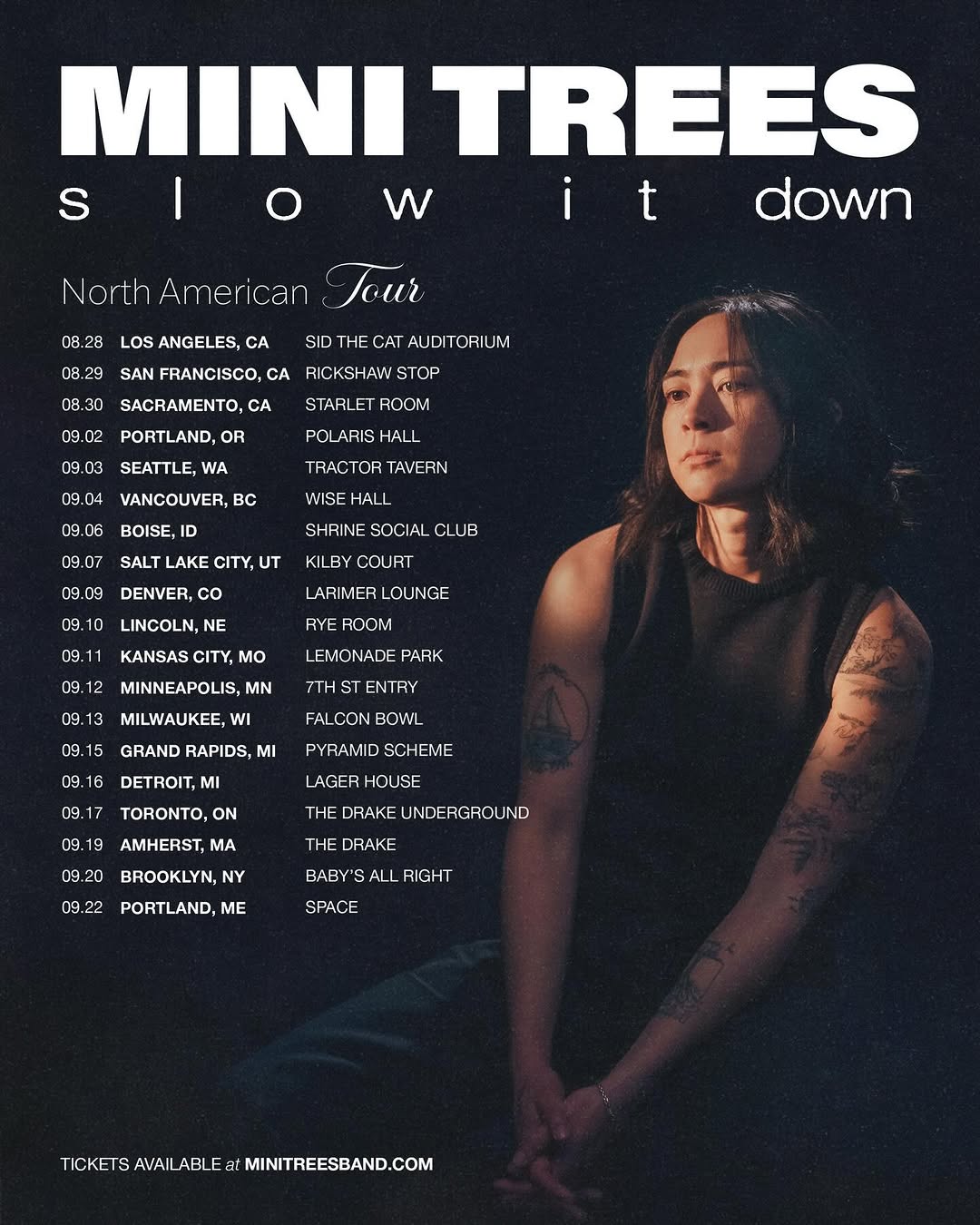
We’re going to announce a bunch of tour dates at the end of this month, which times up nicely with this interview. We'll be hitting the road again in the Fall, returning to some places that we played last year, and then hitting a bunch of new cities that we missed or have never been to. So, I'm really excited for that. The extended version of Slow it Down will be rolling out this year with some new songs as well. And I think after that, I'm just gonna keep going. Keep working on the next record, and just keep doing our thing.
Listen to Slow it Down below:
![DJ Suzy Links Up With Her Inner Kira Krash To Create Transformative Debut Album [Q&A]](https://s3-us-west-2.amazonaws.com/onestowatch-v2/d_j_suzy_photo_by_isak_berglund_mattson-_marn01-1792705738.jpg)
![How Whitney Whitney Lost Her Voice And Found A New Sound On ‘1.3’ [Q+A]](https://s3-us-west-2.amazonaws.com/onestowatch-v2/whitney_whitney-_lead_press_photo(_credit__sol_koi)-1792710354.jpg)