
“TURR4ZO” Is All You Need To Understand Trueno, The Argentine Rapper Planting His Flag All Around The World [Q&A]
Photos by Riley Byington
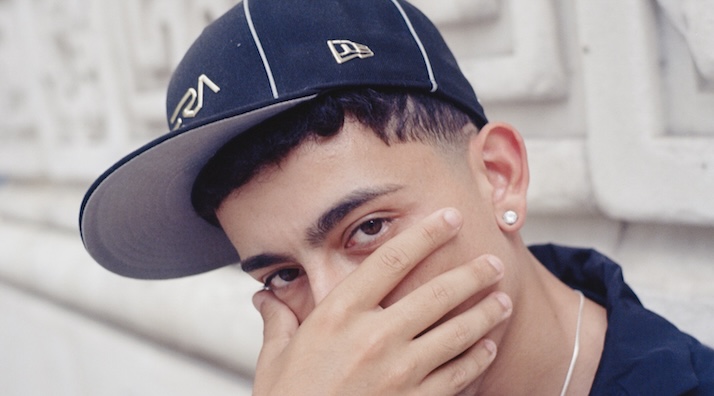
The number “four” is everywhere in Trueno’s world right now, it's shaved into the side of his head and it's in the title of his fourth album TURR4ZO. This is the record where everything that Trueno, a rapper and musician from La Boca, Argentina has been building since day one finally converges into one place. "I feel like it's the one that represents me the most," he tells me. "It has all the necessary dedications: one track for rap, another for my family, another for my Uruguayan lineage, and so on."
That sense of wholeness makes perfect sense when you know his story. Music is not something Trueno chose, rather something he was born into. Both of his parents are musicians, with his dad MC Peligro being part of the “vieja escuela” (old school) of Argentine rap. "I felt zero pressure to do this," he says. "It was more like an influence — a kind of lineage." And tomorrow, the night after we speak, his father will join him on stage in New York, just as Trueno once joined his father's band, a literal full circle moment.
What makes TURR4ZO genuinely extraordinary though is the depth of work that went into building it. For the first time, Trueno threw himself headfirst into the world of sampling, spending hours studying Argentine (folk) music and choosing what works best. "It was the best homework of the album," he says. The collaborations that emerged from that process are equally remarkable and each added their own touch to the songs. María Becerra, Milo J, and then the completely unplanned magic of the song "PITY IN THE SKY", where Pity Álvarez created last minute magic and led Trueno to delete the song he had planned as the outro, and put Pity’s freestyle in. "That was the perfect outro.. and it was totally unplanned." he says.
The result is a trap album that is cinematic, thrilling, diverse in its style and has an incredible flow. And running underneath all of it is the thing that has always defined Trueno: an unshakeable, joyful, defiant pride in where he comes from. In being “turro”, a word that signifies someone from a more working class neighborhood, in being Sudaca (from South America), in being from Argentina and planting that flag — literally — on stages around the world. "I'm from La Boca and I'm here," he tells me, still sounding slightly amazed by it. "That was unimaginable to me."
“I feel like I'm conquering places and taking my neighborhood, my culture and my country wherever I go. For me they're all feats to make people remember Argentina (and my culture) when we're out there. It gives me a sense of responsibility … and I love that challenge … since I represent my people by doing what I love most in this world (music)”. And now, as his world tour kicks off, I have no doubt that people around the world will understand exactly who Trueno is and be thrilled to yell the lyrics to “CON EL COMBO” right back at him, I certainly can’t wait.
Interview has been translated from Spanish and edited for length and clarity.
OnesToWatch: Hi Mateo! I'd love for you to tell us what TURR4ZO, the name of your fourth album, means. Is it derived from the Argentine word "turro"?
Trueno: Exactly! “Turrazo” represents the bigger version of the word "turro", which is what you call street kids, basically kids from a humble neighborhood or a working class neighborhood. I think every country has a different way of saying it and in every language too, but I specifically chose this more Argentine way of putting it, for an album that's about reclaiming my roots, my return to the neighborhood after so much exposure and so many new people joining as fans, you know?
Showing them that I'm the same person I was when I started making music, and that whatever position I'm in, I'm going to represent the same thing and I'm not going to change. So I feel like at the most mainstream point of my career, I put out this album to represent exactly that: my identity, where I'm from, the neighborhood I'm from, the country I'm from and the genre I make.
You (as Mateo) haven't changed, you know you're the same, but do you feel like people from your neighborhood have treated you differently as your career has progressed?
No. The good thing is that I always go back, you know? It's like there are people who don't know me who get starstruck when they see me, but my lifelong neighbors just say "Oh, hey, yeah, Mateo." They're not fans or anything. But my reality did change out in the street, and that started when I began to get exposure and became a public figure, your privacy changes, your routine of going out, where you can go, where you can't. So now I try to experience the neighborhood in a different way and go back with other purposes. To do things, events. Whenever I go back I try to do something meaningful — not just go hang out on the corner drinking maté, but to do something as Trueno too, you know? So obviously things changed, but my love and my sense of belonging remain exactly the same.
What kinds of things have you done when you go back?
We just recently presented the album there and there were like 3,000 people who showed up to listen. I also did an interview in front of the Boca Stadium. We collaborated with Casa Rafael, which is a community kitchen in the neighborhood, and we collected about 500 kg of food for the “pibes” (kids) — things like that, you know? I always like to be present in a more solidarity-driven way. My dad is the one who instilled that in me the most. So whenever we can lend a hand to people there, we do it.
You've said before that when people look at your discography, you want this to be the album they remember you by, the one that tells them who Trueno really is. Why this album — what makes it different from the previous three?
I feel like this album is very biographical. I think the previous albums each hold a part of me or are a dedication to a part of my life. The first one is 100% about my neighborhood, the second is more about the music of my country, the third more about my culture which is hip hop. And this one has everything in one, you know? So I feel like it's the one that represents me the most. There's a personal characteristic of mine in each song, like a dedication to each thing in my life: one track for rap, another for my family, another for my Uruguayan lineage, you know? It has all the necessary dedications and it's the one that represents me the most, and it ends up being a kind of gathering of all the concepts from the previous three.
Did you actually shave the number four into your head?
Yes! With every era I like to change my look and my “skin” with each stage of my career and my life. And this time it was all about the number four, which is dominating the whole concept of the album and everything around me.
You're very well known as an incredible freestyler, and I was wondering — when you were making this album in the studio, did you freestyle a lot of the lyrics or is it something you thought through more carefully?
When I started dedicating myself to music, I started to really enjoy writing too. I feel like it gives me a slightly more introspective window into things, being able to write it out and think through everything I'm saying. But on this album specifically we made "DELIVERY FREESTYLE", which is a genuine freestyle. And I feel like you can tell the difference too of the flow, what I'm saying, the things are different between something written and something improvised. “DELIVERY FREESTYLE” is one of my favorite tracks.
In your expert opinion, what makes a good freestyle?
Everything. From how you flow, how you wrap yourself rhythmically around a beat — to what you're actually saying, to the type of rhyme, whether it's consonant or assonant, there are meters, structures, thousands of styles. I personally prioritize the way of flowing.
This is already your fourth project, which is why the number four is so symbolic. What is something you feel you learned making this project that you hadn't yet explored or experimented with in the first three?
I feel like it was more of a personal learning journey for me as an artist , specifically digging into Argentine culture and music, mostly for the samples, choosing each one and everything. It was a very studious process with the team, just sitting there listening to music. Each person would propose a different sample and explain why, very methodically, you know? And that's something I had never done before. I was always more of just a composer, and I left the beats and all of that more to the producers. But over the last few years I've been producing myself too and getting more involved. It really taught me a lot, like with the samples: why use them? Which part of the song do you use? Which artist? All of that was like the best homework of the album.
There are also a lot of collaborations on TURR4ZO, and it's not just about you, but about each different genre or style that is adapted to each collaboration. I was wondering if there was a collaboration where something unexpected happened.
I think the most unexpected or the craziest one was the Pity one — "PITY IN THE SKY" — because we didn't plan it. We had a song called “Tocando el Cielo”. Out of nowhere Pity managed to be in Buenos Aires at the same time I was there, and I was finishing the album. I told him "Come through, let's hang for a bit." I showed him the song, which was already completely finished, everything done, and he just jumped on it. He freestyled with me, grabbed the mic, rapped, said everything he said which is incredible — and what he did was so good that we deleted the original final part of the song and kept only his part. He was talking about the exact same thing as the song, and for us it was a better ending to the album than me saying it myself. It was incredible and it was something we hadn't planned at all. It was the only unplanned feature.
Actually, yesterday I spoke with Milo J and I asked him this, and I thought it would be nice to ask you too. There are many artists right now going back to connect with the roots of their country's music. Why do you think this shift is happening?
I feel like it's also necessary, you know? Everyone is starting to realize more where they come from. I remember that when I made "Bien o Mal" in 2022, which was also very Argentine and a similar kind of search conceptually, though without samples, there were very few people doing that. C Tangana had just made "El Madrileño," which was an incredible album, and there were very few people within urban music who were really reclaiming their culture.
And now that it's happening across every Spanish-speaking country, I feel like it's the fruit of recognizing the national music industry and the music of each country. It's cooler because it's not just urban music, it's the native music of each place, and it makes Argentine music so much more distinct from Colombian music, from Mexican music, from Spanish music. It makes us stronger because each music is so different and each person represents their own. So it's something that should have happened a long time ago, and that it's happening now is amazing, incredible.
Is there a song you discovered through all of this that also inspired you?
I think from everything, from all the samples we listened to before the beats were born , there were many songs I didn't know that tatool and El Guincho (the producers) were bringing in. It was tatool who perhaps showed me a more folk side with Guti, Roberto and other artists that inspired me. For example, to make the beat for “PUMAS”, which I made with a sample from Chaqueño Palavecino, that really inspired me a lot. Guincho also built the beat for “RAIN IV” with samples from Miranda and Juan Aguirre — artists I obviously know but wasn't deeply into — and I was able to connect with new things that work impeccably as samples, but where you also have to listen to the original song to understand what they're talking about, to make sure they connect to the concept of the track. It was incredible to dig in and learn about Argentine music more than I ever had before.
I love lyrics in general and I always like to ask about them. So the first one I have for you is in honor of the song "X UNAS LLANTAS". Do you remember when you got your first pair of sneakers?
Yes, of course. When I was little I used to see rappers wearing Air Forces and I wanted a pair so badly — and then I always loved Nike Air Max too, always something sporty, and Nike specifically was always my favorite brand to wear. I also remember there were these Nikes called Free Run, made for running, and since I didn't have money to buy the real ones I'd buy the knockoffs because I loved them and they were cheaper.
One of the beautiful themes running through the whole album is the pride of being turro, of being a turrazo, and also the pride of being from South America. You have a song called "ESTILO SUDAKA." For someone who isn't from South America or Latin America, what are the essential components of that style that they need to understand?
I think it's a sense of identity and belonging to the south of Latin America, of our continent — and it has a lot to do with our culture, our history, our style of music, our customs. Turrazo is a word that I'm proud to defend because I'm about as “Sudaca” (South American) as it gets. I'm Argentine, from the south of the world, and I love it. And just as I'm Argentine, I feel like a brother to any neighboring country within Latin America and within my continent. But it's ultimately a sense of belonging. So I tried to reclaim that word, just like turrazo as the album name.
How do you see the role of your music in giving a voice and a beautiful light to our culture?
I feel proud, you know? I'm very attached to my roots, my neighborhood, my culture, everything that shaped me. It all comes with me. And I also make it clear that I'm proud of Latin America, of Argentina, of La Boca (my neighborhood), of Buenos Aires, of hip hop, of Argentine music. It's what I have, it's what I was raised with and it's what's going to come out of me when I sit down to write on a blank page, because it's what formed me.
In the song "PUMAS" you talk about “planting flags all over the world”, and you just played in Japan, and tomorrow you're here in New York. How do you feel an international audience has been receiving your music?
It's insane. And going back to what you said at the beginning about planting flags, for me that's something incredibly powerful, because whenever I'm in a new place or a new country, that thought always comes to me ”I'm from La Boca and I'm here, you know”? That was unimaginable to me. So I wrote it into PUMAS for exactly that reason — I feel like I'm conquering places and taking my neighborhood, my culture and my country wherever I go. And luckily opportunities like this keep coming. For me they're all feats to make people remember Argentina when we're out there. So I take it seriously, I give it the weight that it deserves, because if I'm going to say it I have to actually deliver and leave people with a great impression. And in Japan, we played there and there were people in the crowd wearing Boca jerseys. That genuinely blows my mind because it's literally the other side of the world and we're present there. It gives me a sense of responsibility.
Does that responsibility ever weigh on you, especially on the other side of the world where people rarely know us, does it feel like a burden to have to represent Latinos, Latin hip hop?
No, the opposite. I love that challenge. Your mind always tells you "you have to represent it well, you have to kill it", but since I represent it by doing what I love most in this world, it's not a problem. In a way I'm so glad the responsibility fell on me. Just like there are other responsibilities that fall to others — I love being the one who's present in this moment and I'm going to make the most of it.
In the song "RAIN IV," which you wrote for your parents — and which I found so beautiful because it's like your story — both your parents are musicians, and in the song you say "...when I'm old, I want to be like my old man." It's like you want to be like him as a person, but at the same time do you feel a responsibility as a musician to make him proud and reach his standard?
Yes. Today I feel like on the musician side, thankfully, we've already achieved that. It's something we share — tomorrow we're actually going to perform together here in New York. He sings with me just like I used to sing with him in his band. So it's something we both share now. Both my father and my mother — my mother is also a musician — all my family members are artists. So I felt zero pressure to do this, it was more like an influence, a kind of lineage.
But that song is more of a personal admiration than an artistic one — though I admire both of them as artists too. It's more of a child-to-parent thing and every line comes from that personal place, though it mixes together because we also share art with both of them and we're always talking about music, I show them unreleased songs, they come to shows. With my dad I perform, with my mom we talk about other music — she showed me a more alternative side. Thanks to her I discovered rock and roll and other kinds of music that shape who I am today. So the artistic and the personal are all mixed together.
You really had no choice but to be an artist (laughs). Who are the artists you're watching right now?
I watch a live session a lot called JoMa Sessions, where there are a lot of emerging Argentine artists I really like. There's a rapper called CEROUNNO who is very good, doing boom bap. There's also Doly Flackko who does more of a Detroit style and is killing it. I feel like you have to keep an eye on the emerging artists of Argentina. We're a scene that never gets tired, you know? New artists are coming out all the time. That's very “piola” (cool).
Listen to TURR4ZO below:
![Fai Laci Challenges the Elephant in the Room [Q&A]](https://s3-us-west-2.amazonaws.com/onestowatch-v2/i_m_g_9194-1790300404.jpeg)
![Meet dvd, Colombia’s Next Breakout Artist [Q&A]](https://s3-us-west-2.amazonaws.com/onestowatch-v2/foto2-1790271944.jpeg)