VITA Is Taking Her Power Back [Q&A]
Photos by Mikayla LoBasso
There has never been another VITA. An artist who melts genre and maintains devotion to her truth, the Australian singer-songwriter is one of the most important voices to emerge from the new class.
Though her most recent body of work, OPIA, stands as her debut, VITA has enchanted the industry since moving from Sydney to Los Angeles at just 18 years old. It was then that she connected with California-based producer Naz, who helped give shape to the unique sound she’s pulled from within. With a bleeding heart and passion for alchemy, every single and EP served as a step towards OPIA, the most grand, sonic expression of her artistry.
Full of color and gun smoke, the album is as intimate and vulnerable as it is electrifying and bold. Her affinity for maximalism never drowns out her sincerity.
OnesToWatch sat down with VITA just hours before the album was released to talk about shame, growing up offline, and surrendering to who you’ve always been.
OnesToWatch: 2022’s “YTB” continues to be in my rotation because of how viscerally you captured rage and anger on it. You’ve since only continued to master the art of bottling emotion in song. Where does that come from?
VITA: That's a great question. Thank you so much for having been on the ride with me. The song “Nobody Knows Me like the Piano in My Mother's Home” by Sampha makes me cry because that sentiment is so true to the dysfunction that I experienced as a child and safety that I found in music. I'm a very vocal person, and if you ask me a question, I'm an awful liar. I'm gonna tell the truth. I think that there's just certain parts of myself, especially with my shame, that I have a really difficult time communicating. When it came to alchemizing my difficult emotions, music was really the only way that I felt safe enough to do so. The first project was a lot about anger and that's something that I have a huge problem with. A lot of the people in my life who've known me for my whole life have never heard me scream. That album was really interesting for them because the people closest to me actually got to learn about me through my music.
You seem so unbound and in full acceptance of everything that you feel. Is that a product of any work that you've done outside of music?
Yeah. I think you have to lose a lot of things in your life to have a level of understanding about what you wanna keep. This album is so open because I had to be completely honest. I remember when my creative partner Naz asked me initially what I wanted to write the project about, I said shame because that was something that I hadn't touched on. The things within me that I hadn't been able to explore because I was so shameful. I have this idea of what being a good person is, and the scope of what is good and bad is completely unreasonable for myself. But when it comes to others, I hold so much space for people to live their human experience. I don't punish people for being who they are, even if it means that they make massive mistakes, even if they've betrayed people. In my heart, I believe everyone is redeemable, but I don't treat myself in that way. The work that I did was really to not just be open about the things that I was comfortable with, but to put myself in a position where I was forced to confront my shame every single day. And it was a deeply uncomfortable experience, having to speak to my collaborators about what I'm writing about. I couldn't hide.
You’ve mentioned that “the most mentally ill year of my life” was where this album came from, and I believe you have to be destroyed in order to become who you were supposed to be. Would you say that there's gratitude for the destruction?
Yeah, absolutely. I’ll meet somebody who just seems like they're easy sailing, like they go through hard things and it's still really easy sailing and I’m just looking at them like, “You seem really regulated and chill,” and then I look at my life and the way that things unfold and I'm like, “Bitch, what? Somebody is doing voodoo, somebody conspiring, 'cause when it rains it pours for me.” It's not like I've had a couple instances over the span of my life. It's more like I have these periods of very, very intense death in multiple different ways that morph into this huge metamorphosis, which is why as a creative, everything that I make sounds different. Every era sounds different. Because I fundamentally shift as a person. I take a lot of left turns. But I am really, really grateful. In the moment, it's easy to victimize yourself. If I have the lens on that the universe is conspiring against me, then I will be a perpetual victim. But if I have the viewpoint that the universe is conspiring for the greater good, then every death is a chance at rebirth instead of a chance at being stuck, and I think for a lot of my life I was really stuck because I didn't want to confront the shame. I am not a victim. I am actually a participant in these things happening. I’ve lost entire friend groups. I've lost relationships with my family members. I've lost so many things, but I think through loss, I've been able to gain so much clarity about what I will and will not tolerate, what I will and will not do in this life, and having a greater path of empathy for myself and other people because judgment almost always comes from a place of projection and shame. I'm very grateful for every time that a huge chapter comes. This year was maybe the most grief that I've ever felt, and it was crazy to be coinciding with this album being made. Everything was absolutely meant to be, because I don't think without this kind of clarity from writing this music that I would have the intense amount of gratitude that I have for the experience. I would have let it crush me.
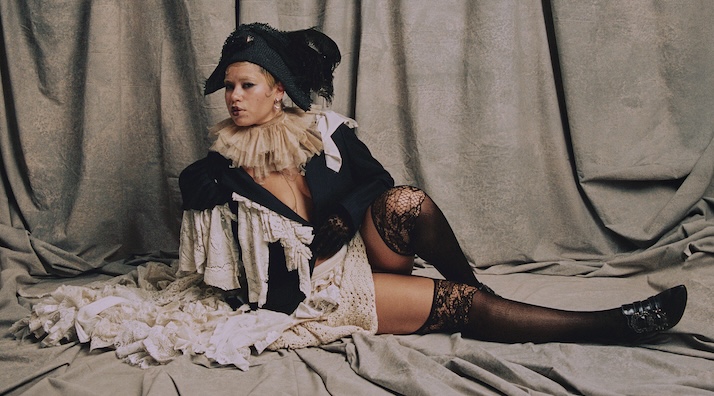
This project feels so tangible and very immersive. I'd love to know how you curated exactly how you wanted to tell this story visually. It's so camp.
When I was exploring the visual world, I was also trying to implement the duality that I feel as a woman. I'm a deeply introspective, deeply vulnerable, deeply sensitive person, but I'm also a fucking diva. love to perform. So I wanted to build this campy, extravagant sort of universe that embodies the performer in me, that embodies the person who wants to be the loudest voice in the room, who wants to be the most confident. I always play with a level of juxtaposition within my art, with the music being so vulnerable and so open, juxtaposed with this really extravagant world that's almost absurdist in a way. I wanted the visuals to lead through this story of the girl who's doing too much. She's always she's out at the party, she's outside, she's doing her thing, and then she's waking up on the ground, every single day doing the same thing, and it's groundhog day. It's a representation of that coming of age story. I grew up watching Skins and I always like to say that I was Effie, but I was probably more Cook than anything. I was definitely a little bit of a psycho. I wanted to represent that side of me as well. Coming from my twenties into my thirties, me being that crazy drug adult teen into my early twenties, living life really fast and being the person that I am now.
You carry every single version of yourself that you've ever been. While listening to “Pleaser,” I sat with the fact that I have no issue embracing who I was as a child, but I'm very, very hard on my teenage self. There's a lot of shame that I still carry around her. I'd love for you to speak to the peace that comes with making amends with who you've been.
It's a duality thing again. Holding immense pain with pleasure and joy. I think as women, we have a hard time with duality in general. We don't have the space to make mistakes. We don't have the space to work through it. There's “boys will be boys,” but there's “no girls will be girls.” We carry shame about everything that we've ever done. A fifteen-year-old girl cheats on her boyfriend, she'll carry that shame for the rest of her life. Do you think a fifteen-year-old boy is gonna have that same experience? Absolutely not. Holding the contradictions that we have as women with grace and with care, that's why “Pleaser” was so important, because there's so much contradicting language in it. Like, I’ve been a self-indulgent people pleaser. I can be very self-centered, and then on another lens, I can be the person who sacrifices everything about myself in order to give myself to somebody else comfortable, I’ll put my discomfort aside to make everybody else feel good. Both of those people exist inside of one person. I had a really hard time understanding if I am a good person, or what a good person even is. What if that doesn't exist? What if I'm just a fucking human? I’m forgiving myself not just for making those decisions, I'm also forgiving myself for punishing myself for being human. I think a lot of women struggle with that just in general.
You're among such a fruitful ecosystem of rising female artists right now. So many different girls who are weird and alt and camp are getting championed right now because we're craving authenticity. How do you feel about being a woman in this current industry?
I feel really amazing. I have a huge community of emerging artists that are championing me. That's one thing that has given me an incredible level of confidence walking in at this level. I really do feel like I'm stepping into an environment where everybody feels like they can have a piece of the pie because women have realized that the competition that has been pushed for us to have is actually distracting us from being the most powerful that we can possibly be. It's been used by men for millennia in politics, in business, to keep women fighting each other so that we don't see how powerful we are, so that we can’t build these empires for ourselves. There's been an era of bedroom music and it's been fun and sexy, but I feel like people are yearning for maximalism. People are yearning for the big and challenging sounds that came from the ‘70s, ‘80s, ‘90s and early 2000s. People are redefining what pop music is because the listener was saying that they were bored, but the only people that are buying records are the ones that want classic, run-of-the-mill pop. So the listeners are also being extremely challenged into being like, “No, I have to ride for the artist that I want to see succeed, so that I can also be a part of the movement.” It's not just about the artist anymore, it's about the listener, it's about the consumer. We are in an era, especially with the internet, that people are finding new ways to identify with a niche that speaks to them and that's why I'm really excited. There's a lot of things to complain about within the TikTok era, but on a positive level, there is so much more access. At the beginning, because I'm not an internet girl, it was really difficult for me to connect. But I'm getting all these messages from people who feel extremely touched by the things that I'm making. I went to the FKA Twigs concert in Mexico City and it was something that was so uniquely her that I thought to myself, “There will always be people in this world that will challenge the idea of what a pop star looks like.” It's just more motivation for me to, without a lack of better words, put my whole bussy in it. Go hard in the paint. Think of the most crazy idea, maximalist idea. Even if we can't make it, we scale back, but at least we ran for the hills.
I'm part of that audience craving maximalism because that's what it feels like to be alive. It feels so savage to be alive. You mentioned not being an internet girl, is that something that's intentional?
I think it's just the way I was raised actually. My dad's an environmentalist. My mom's a musician, but they're both very hands-on people. She’s an artist in every sense of the world, but she’s also very integrated into science. My dad is an incredible renewable energy specialist and I grew up with a lot of outside time. I'm a bush girl. Going to the beach, being outside. I’d just be doing science experiments with my dad in the house. In his teen era in Australia when he was growing up there, he had a laboratory with all of these illegal chemicals in this bunker underneath his swimming pool. It was very like evil genius. I was very invested in science and play so I wasn't really on the internet. We didn't have a lot of technology in the house. Me and my brother have this running joke about how one of our favorite movies was this VHS they had of a train going through Switzerland or something. The only time I was really watching movies was when I was going over to my Filipino aunt's house and she was playing Zorro on repeat.
That's so healthy. Your brain is probably like, fully formed.
I'm really excited that I actually had that experience. When I moved to America, people were telling me SpongeBob jokes and I didn't know what they were talking about. They were like, “Are you an alien?” I moved to America during the Vine era, it was like people were speaking in code. I was so confused.
We're obviously referring to OPIA as your debut because it is, but it also feels like we've known you for so long. How does putting this project out feel different, especially with weight of it being your official introduction?
I feel an incredible sense of relief to be signed to a label that believes in me and is showing me a lot of care and belief. I feel really inspired because I have a support system around me, my managers, my team, the label, everybody who I've worked with externally. I've been building this team for what seems like five or six years now. Yes, I'm putting the music out and yes, it's my debut album, but I'm so much more grateful for the people who have gotten me to this point. That reflection makes me really emotional because it's the first step out of a bunch of other steps that are gonna happen. And it feels weird because I've made a bunch of small steps before this one. But this feels like the first big leap. It's a testament to the faith that I have in myself and the people have around me. When I was making it, I was like, “Damn, I've made a lot of projects and this is my first album,” but then I think about Zara Larsson or Tinashe, so many artists who actually popped off in the last year that have been in the game for so long. I have an incredible level of patience and understanding and knowing if it's not this one, it's the next one. It's not the next one, it's the next one after because I'm never gonna stop. It makes me excited that I have an engine behind me because I'm not having to trudge it along myself. That belief keeps me going.
And you've been very forward about expressing gratitude for your creative collaborators, including Naz.
Yes, he’s been my producer and creative partner for the last ten years. He was the first person that I met in Los Angeles. When I moved to LA, I didn't know anyone and I didn't know anything. I was just like skateboarding down the beach, asking people if they had weed or made music. I went to a party with this guy, and I ran into Naz, and coincidentally, the artist he was working with was out of town for two weeks, so we locked in. He showed me how to be a recording artist, he showed me how to engineer, he showed me how to produce. We've been developing together for the past 10 years. He is a huge part of what this is. I think maybe even I would say the most integral piece besides me, to what makes this what it is, because it is really 50/50, me and him. He's the one who's been championing me from the very beginning and he's a future legend. I’m waiting for people to catch on.
When you're working so closely with other brilliant minds, but you're also making music that's so personal and deeply embedded in your trauma, do you have to bypass certain boundaries about what kind of song you’re writing while still maintaining the integrity of the piece?
Oh yeah. I've just been walking into sessions and putting my guts on the table, like, “What does a bitch have to lose at this point?” Absolutely nothing. I have everything to gain by being completely authentic from the jump. It's been strange because I walk into spaces with people who have made the records that shaped me as a person. And then I just have to be like, “So this happened to me when I was a child.” It's such a crazy experience, but I think that level of rawness has helped me break through my nervousness of having to be in those rooms. That’s one thing that I realized, especially after I had the session with Justin Timberlake and Timbaland. That session changed my perspective on a lot of things. Sometimes, when you walk into rooms with people who you've admired so much, you think, “This is gonna change my life.” But after that session with Timberlake and and and Timbaland, I realize I'm not I shouldn't have the expectation that this is gonna change my life, but that doesn't mean that it's not life changing. Just to be in the room with somebody like that, to get that kind of affirmation. That’s the energy that I took into all of these other sessions. People are just people. I’ve idolized Justin Timberlake since I was a kid. Being in the room with him, we're just chatting shit. And I'm like, “Okay. I actually had nothing to be worried about.” Because honestly, my value systems are based on, are you cool? Are you nice? Are you gonna be nice to me? If you make really amazing music and then I walk into the room and you act like you're hot shit and you're a dickhead to me, then I'll never work with you again. I was really lucky to be in rooms with absolute legends who are also some of the most incredible and open people that I've met. I think it's because I came in with that kind of attitude. I'm a human being. I'm dealing with some really rough shit right now. I'm dealing with my childhood trauma. Here it is. Let's discuss.
I think the more human you are, the more you'll welcome those kinds of experiences. The album is out tonight, how are you feeling?
You know what? I feel really amazing about it. It's been a whirlwind the past eight months. I moved countries, I filmed two music videos, I did three different content shoots, I traveled to different cities and I had a little press tour, then I did my release parties and now I'm back in Mexico City and I'm like, “Whoa, I moved here eight months ago and I've barely been here.” The last couple of days, I've just been crying so much and it's this really intense level of gratitude because everything that I prayed for I have in front of me and regardless of the personal struggles that I'm going through and the amount of destruction that seems to be happening in my personal life, I really am proud of myself for making this project in the midst of what seems like the craziest personal hurricane of my life and everything that's happening in the world and having to juggle my personal relationships with making an album and being a woman and dealing with chronic illness. With past projects, I wouldn’t have even known how I felt. I was so burnt out by the end of it that I was just like, give it to the people. But I feel very energized about this. I feel very grounded about it. I'm going to show people a side of myself that I've never shown before and my family's about to hear it. It's as daunting as it is relieving to feel like I don't have to live in shame, because shame lives in dark corners where nobody can see it and now I'm broadcasting it with a megaphone. Here's my shame. I don't have to hold it anymore. It’s a weight off my shoulders. I feel like I'm living in the city that I've always wanted to live in and I'm psyched. I have everything that I've ever wanted. I have the best team in the world. I'm just stoked. I feel like this is the first step into the rest of my life.
Listen to OPIA below:
![A Night Out in New York With Nautics + Their Debut Album “People Only Like Me When Im Leaving” [Q&A]](https://s3-us-west-2.amazonaws.com/onestowatch-v2/d_e_v_5828-1791220348.jpg)
![LIA LIA Infuses Nostalgia for an Unknown Memory into Album, Armor [Q&A]](https://s3-us-west-2.amazonaws.com/onestowatch-v2/l_i_a_l_i_a1-1791234524.jpg)