
FLVCKKA Is Blending Hyperpop, Corridos and Other Genres Into Her Own Lane with “Hypercorridos Vol.1”
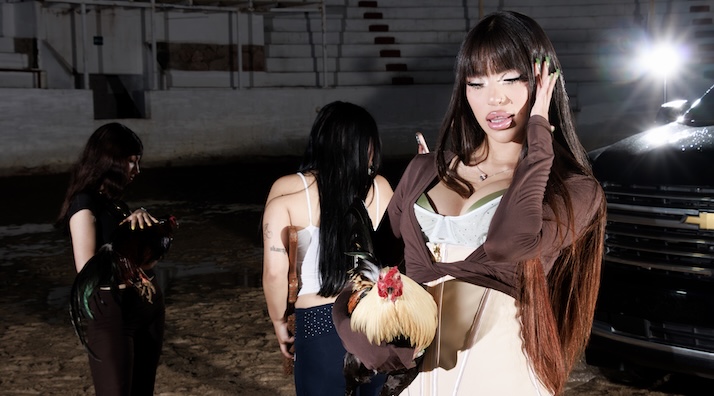
Photo by Cris Rodriguez
Mexico has produced a wave of musical talent and genres influencing today’s pop culture, and has given music lovers new sounds to discover. FLVCKKA is a singer, rapper, and songwriter to keep on your radar. She brings a new touch to music by combining different sounds, cultures, and rhythms into something all her own. Imagine hearing a corrido with hyperpop notes woven into it, or recognizing a song that started in another genre but now lives on a corrido-style type beat with Mexican influences, reimagining something we’ve heard before. That is FLVCKKA: bringing something new to our palates while staying true to the authenticity of what she has lived and grown up around.
Originally from Chihuahua, Mexico, she represents a new generation of what music from Mexico can sound and look like. She performed in New York for the first time in July and will continue showcasing her music in the States in the coming months.
Her project Hypercorridos Vol.1 includes 16 tracks, 14 of them produced by Angely2k. With it, she is introducing the world to hypercorridos (hyperpop and corridos) and a movement known as Neobuchonismo. The album blends hyperpop, jersey club, funk, trap, reggae, and features collaborations with Chino Pacas, Régulo Caro, and others making waves in the regional Mexican music scene. She is also part of YouTube’s 2026 Foundry Class.
Seeing a woman in a male-dominated genre is encouraging, something FLVCKKA spoke to during our interview: “We can be aggressive and strong, too, and stand our ground just like men who have that same aggression and strength.”
Read the full interview with Ones To Watch below. This interview has been translated from Spanish to English.
OnesToWatch: You blend hyperpop, buchón, funk brasileño, and corridos in your music. What's your first memory of encountering these genres, and when did you realize you wanted to make music that combined all of them?
The first time I saw trap combined with regional Mexican music was with Herencia de Patrones. They’re a group of guys who make corridos, but they’re from the United States, and their style is similar to trap. Their lyrics are more trap-like too, with a lot of flexing. That’s when I saw the combination, although I already had those genres mixed together in my head. Seeing them do it made the idea real for me. Later, I met my songwriter in Guadalajara, whose name is Yorkca. He was doing something similar, but instead of corridos, he was making traps with corrido-style lyrics. That helped me see it even more clearly, and when I started working with him, I began doing it too.
When selecting the features for the album, what was your process for deciding who to include?
I wanted to work with artists who were part of the regional-urban scene. There are a lot of artists who don’t make regional music now but come from that scene and are currently making things like trap or Detroit-style music, like Omar Camacho, whose collaborations are often with regional artists. I feel like they’re all part of the same scene: artists who make corridos and música urbana bélica. Since that was the mix I wanted to create, that’s how I chose them. Almost all of them said yes, and they also got to experiment with what I’m doing. What they made with me was new for all of them, which is part of why I chose them.
I'm Ecuadorian, and I recognized Julio Jaramillo's influence in "Amor Bandido" — whose idea was it to use an Ecuadorian rhythm and layer rap/urban beats on top of it?
It was my idea. I’ve liked Julio Jaramillo for a long time, and I have songs with lyrics that are partly inspired by him. I have a song called ‘Le tiré’ that was inspired by “Ayer y Hoy.” It's very different, but I drew inspiration from that song. I really like Julio Jaramillo, and I wanted to sample his music for a while. This time, the artist I collaborated with, Jan Glack, said he didn’t want anything hyperpop or anything too cute. So I thought, ‘Dude, I don’t usually like sampling rhythms that sound very—I don’t know how to put it—very Mexican and traditional.’ But this time I wanted to include it, partly because I knew he’d like it. In the end, I really liked how it turned out.
You performed at the Latin Alternative Music Conference (LAMC) in New York. What was that experience like for you?
It was really cool. I’d never been to New York or performed a showcase in the United States before, so getting to see the city and attend all the conferences was really great. I thought the opportunities they give Latin artists were really cool. I was also surprised that so many people came to see my showcase; I wasn’t expecting it. I saw lots of people singing and dancing, and after I finished performing, a lot of people came up and asked me for photos. I really didn’t expect that. But I feel like my music is really catching on in the U.S. right now, so it was a little glimpse of how well it might be doing over here. I’m also really grateful that LAMC gave me the opportunity to travel around there.
What was your favorite part of working on this album?
My favorite part besides getting to see other artists is really liking working with my rhythms and sounds, which I loved, hearing them experiment with sounds and things they’d never done before. My favorite part was how much the album evolved. When I started it, it was one thing; by the time I finished, it had completely different influences. The last song I recorded for the album is a música bélica reggae track. I started in one place and ended up somewhere else because I kept exploring and evolving what I wanted. I’d think, ‘No, I don’t like this anymore; I need to take it to the next level.’ It was a whole process, and I think it ended up as a really cool combination of genres and sounds, not just hyperpop.
As one of the leading female voices in Mexico's urban music scene, what does it mean to you to be expanding space for women to lead in this genre?
I’ve really liked seeing how many girls and young guys have been inspired by what we’re doing and by our sound. When we started making this hyperpop, it wasn’t traditional hyperpop; it was a combination of R&B, Jersey, aggressive lyrics, and other elements we brought together. I love seeing that people now want to make it and replicate it.
I feel like Mexico used to be pretty closed off when it came to genres. Of course, there’s always been an underground scene experimenting and doing all kinds of things, but I’m talking about bringing that into the mainstream and taking it further. Now I feel like a lot of people who are already in the mainstream want to try those things. They reach out and say, ‘Hey, I want to do something like what you did here,’ or ‘I want to do what you did there.’ I like that. I think it’s really cool that people want to experiment with something new.
What do you want people to know about you after listening to this album?
I’d like people to understand what my real message is and not get the wrong idea just because the lyrics are a little violent or because I stage certain things. I want people to understand that it’s entertainment and that it’s part of our culture. I simply want a woman’s voice to be able to stand alongside the biggest male voices who make and write the kind of music I do. Girls aren’t only here to make pretty, cute things, behave perfectly, or always be sweet and easygoing. We can be aggressive and strong, too, and stand our ground just like men who have that same aggression and strength. That’s the real message I want people to understand about my project as a whole.
What's next for you?
I’ve done several collaborations that won’t be released under my name but with other artists, and I think people are going to really like those songs too. You can expect collaborations with artists people want to hear me with. I’m also already working on my next album. I started thinking about this second album long before I made this one, so I’ve been changing some of what I originally wanted to do with it. It’s going to be more urban and even more aggressive. I plan to make it more mainstream and collaborate with much bigger, global-level artists. You can look forward to that. That’s going to be my real album. The real one.
Listen to Hypercorridos Vol.1 below:
![La Niña Is Learning to Let the Unknown Lead Her Ahead of US Debut [Q&A]](https://s3-us-west-2.amazonaws.com/onestowatch-v2/eleonora_albano-_d_s_c05998-1791394944.jpg)
![VITA Is Taking Her Power Back [Q&A]](https://s3-us-west-2.amazonaws.com/onestowatch-v2/copy_of_m_i_k_a_y_l_a393042468-_r1-015_photo_by_mikayla_lo_basso-1791244306.jpg)
![A Night Out in New York With Nautics + Their Debut Album “People Only Like Me When Im Leaving” [Q&A]](https://s3-us-west-2.amazonaws.com/onestowatch-v2/d_e_v_5828-1791220348.jpg)