
Ishmael is the New Picasso Making High Art Hip-Hop [Q&A]
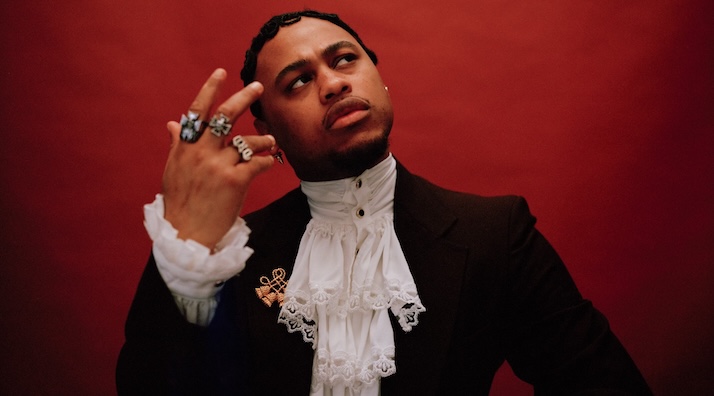
Before he was soundtracking campaigns for YSL Paris, working with hip-hop juggernauts like Ciara and Vince Staples, and collaborating with luxury brands, Ishmael was just a kid from Rochester, New York, trying to figure out where he fit in. “I was in the street, in the hood, but I always felt adjacent,” he says. Raised in a strict Christian household where gospel and jazz filled the house, hip-hop found him through BET at his grandmother’s home and a school project that inspired him to write his first rap at 8 years old. By 12, after years of relentless feedback from his older cousins, he was recording in the studio, and art school expanded his creative world through choir, theater and vocal performance while introducing him to artists like Frank Sinatra, Kanye West, Kid Cudi, Phoenix and Coldplay. “That’s embedded in my DNA since seventh grade,” he says.
Ishmael’s career has always balanced instinct with ambition. His breakout single, “Bimmer Music,” wasn’t intended to be a defining record, but listeners connected with its loose, joyful energy. After signing with producer Paul Epworth, he spent months in London making his most ambitious music before the pandemic dissolved his label and brought that momentum to a halt. “You can tell I’m smiling when I’m recording the record,” he says. “Energy within songs becomes nostalgic for other people,” a realization that forced him to choose between chasing another “Bimmer Music” or fully committing to the more experimental ideas that inspired him.
That decision materialized as “New Picasso,” a track that exercises Ishmeal’s mission to create something bigger than the music. Ishmael approaches every release like a creative director, shaping everything from the visuals and fashion to the storytelling himself. That vision has already led to moments like his YSL campaign and a performance in Paris, but he’s equally committed to creating independently, whether that’s shooting videos in front of museums across New York or cultivating a community around his work. Rather than chasing trends, he’s focused on creating a body of work that feels complete and unmistakably his own. In the conversation ahead, Ishmael explains how he’s building that world one record, one visual and one idea at a time.
Ones to Watch: Let’s start with your creative DNA. Who is Ishmael? Where did you grow up, and what music was playing in the house?
Ishmael: I’m from Rochester, New York. Upstate. It was rough where I grew up, but I always felt different. I was in the neighborhood, but I felt adjacent to it. I knew I had to find my own lane. Growing up, there was no secular music in the house. It was gospel and jazz — that’s it. If my mom caught us listening to anything else, she would hand us Nicole C. Mullen and Kirk Franklin CDs and say, “This is what you’re listening to.” My music teacher gave us a project where we could write any kind of song, so I wrote a rap. I was 8. We didn’t win, but I kept rapping. My cousins, Young Sleep and Class Murder, were rappers in Rochester, and I’d call them every time I wrote something. They’d tell me it sucked. Then one day, they said, “That’s actually good. You should go to the studio.” I was about 12, and I’ve been recording ever since.
You also went to arts school and sang in a touring choir. How did that shape you?
Arts school changed everything. The option was either go to arts school or go to school in the hood, and at that time, gang activity was everywhere. Arts school felt like a way to be safe.
I auditioned for vocal performance, then got pulled into drama and musical theater. I did Peter Pan and Joseph and the Amazing Technicolor Dreamcoat. Musical theater literature became one of my favorite classes because I learned about Frank Sinatra, Fred Astaire and all these different kinds of music.
At the same time, I was rapping. Then my cousin gave me 808s & Heartbreak. At first, I was like, “Why are you giving me this? I want to listen to Wayne.” But that album changed my life. Then I got into Kid Cudi, Phoenix, Coldplay and all these other sounds. It made me realize I didn’t have to just rap. I could sing. I could use harmonies. I could produce. I could experiment with structure.
That’s been embedded in my DNA since seventh grade.
Your teachers later encouraged you to leave college and pursue music. What did that moment mean to you?
I was in college for vocal performance, and my teachers called me into a room. There were like 10 of them. They closed the door, and I thought I was in trouble. Then they told me, “We think you should drop out.” They said somebody showed them the music I was making outside of school and that I was wasting my time there. They were like, “We all want to do what you’re doing.” My manager had already been telling me to drop out and lock in, but I knew my parents would be mad. So hearing that from my teachers gave me the confirmation I needed. I always felt like I was talented, but I also feel like my purpose is bigger than music. I want to impact lives. That moment helped me take the leap.
You recently worked on a YSL campaign. How did that opportunity come together? Had to mean a lot coming from someone who loves fashion.
It came from a session I did three years earlier. We made a song and never finished it, and then I didn’t talk to him for years. Eventually we started talking again, and randomly he was like, “I do a lot of work for this agency. Do you want to do a YSL commercial?” We locked in the commercial, they put out the record and flew me to Paris to perform at the release party. Steve Lacy was there. Paris Jackson was there. I got to meet Austin again. It was the first time I felt like, “This is what this is supposed to feel like.” I cried in front of the Louvre.
“Bimmer Music,” was the song that gave you your first major platform. What do you remember about making it?
“Bimmer Music” was a joke. I had just come from South by Southwest. My voice was gone. I had been hanging with Post Malone right after “White Iverson” and just having the time of my life. Then I got to Chicago and recorded a bunch of songs. “Beamer Music” was one of them. My manager was like, “You have to put that one out.” I was like, “That one? Not that one.” But I trusted him. Pigeons & Planes premiered it, and within a couple hours, somebody from Goldenvoice reached out to book me for Day N Night Festival. Later, the guy who booked me told me, “I don’t even know what your other music sounds like. I just heard ‘Beamer Music’ and booked you.” For years, people told me they loved that song because they could tell I was smiling while recording it. They could tell I was having fun. That taught me that energy becomes nostalgic for people.
Did that success ever make you question whether you were making music for yourself or the audience?
Ishmael: Absolutely. That’s been the biggest hurdle of my career. Am I making music for you, or am I making music for me? When I dropped my first single with Paul, it was called “Peace,” and it didn’t blow up. I thought once I was signed, everything I dropped would be big. But when you sign, you start over. You’re back at ground zero, just with a machine behind you. When the label dissolved, I thought, “I only dropped ‘Peace’ and went in this avant-garde “New Picasso” direction because I thought I’d have a platform. Now I don’t have one. Do I need to go back to ‘Beamer Music’?” With “Beamer Music,” I don’t have to convince people. The world is simple: I’m outside with my people, smiling. It doesn’t take money to create that vibe. But when you want to be perceived a certain way artistically, it gets harder. At the end of the day, though, we don’t decide. The people decide.
“New Picasso” feels more conceptual and refined. Where does that inspiration come from?
“New Picasso” is 12 years old. It’s refined now, but it’s been with me for a long time. I played a trusted homie the project, and he told me it was too polished. I was like, “What do you mean?” Then I played him music I made 10 years ago, around the original Picasso era, and he said, “That’s your foundation. If people don’t get your foundation, how are they going to see you grow?” With songs like
“Beamer Music,” “365,” “Maria” and “Problems,” the mood is obvious. People get it right away. Anybody can be outside with their friends. Anybody can get their heart broken. The world-building is easy. But when you’re trying to communicate something more intellectual or artistic, it’s harder, especially without a budget. You start thinking nobody will understand because you can’t world-build like Ye or Tyler. Would we love Yeezus the same way without the Margiela mask? Would we remember the Watch the Throne tour the same way if it didn’t look the way it looked? I don’t think so. Presentation matters.
How do you accomplish such a high-value product without major label backing?
I decided to do what I can. You have to start somewhere to get somewhere. I may not have the big-budget video, but I wrote a 10-page PDF about what this project is — the motifs, the mood board, how I’m going to dress, how my hair will look, everything. As long as I feel like New Picasso Ishmael, I can be that anywhere. A homie once told me, “Stop telling people you dress well. Just dress well.” I think about music the same way. Somebody is going to see the work and think I’m great. As long as I’m OK with it and it represents me, who cares? I’ve been shooting and editing my own videos for 10 years. So I was like, “I’m going to go outside and do this myself.” It’s called “New Picasso.” I’m going to shoot in front of every museum in New York.
What part of the creative process do you love most?
Recording is fun because it’s intimate. That’s when I’m most connected to my thoughts.
When it comes to video and photo, I know it would be 10 times crazier with extra hands. But making the music, producing, mixing with my homies Rico and Tyler in Chicago — that’s when I hear everything come to life. Making the music and building the creative concepts are my favorite parts.
What’s next for Ishmael?
There was a point when all I wanted was growth. I didn’t care how fast it happened. I just wanted to grow. Now, I know I’m here to impact lives. I have something to say. I’m giving the game substance, but I still want to have fun. Don’t get it twisted — we’re making avant-garde stuff, but we still like to turn up. What’s next is giving people a project. After years of rapping and putting out singles, I think the world deserves a body of work from me. I owe it to myself. More than anything, I want community. I want people to be able to identify an Ishmael fan the same way they can identify a Ye fan, a Tyler fan or a Travis fan. I want community to happen around my records. I want nostalgia to happen around my records. I took a hiatus from social media because I felt like I was moving like an influencer and not an artist. Now the likes and shares don’t affect me the same way. I’m looking for camaraderie in the comments. I’m looking for people to see themselves in the records. If my music can bring people together, I’m happy. But it’s my job to keep giving it to them, and I have to hold myself to that.
![BOY SODA Dives Deeper Into SOULSTAR With His Deluxe Edition [Q&A]](https://s3-us-west-2.amazonaws.com/onestowatch-v2/untitled-1790796922.jpeg)
![Maria Fuell Is Bringing the Sounds of the Andes to a New Generation [Q&A]](https://s3-us-west-2.amazonaws.com/onestowatch-v2/i_m_g_9202.jpg-1790624210.jpeg)
![corook x Whale Songz On the Art Of Following The Fun [Q&A]](https://s3-us-west-2.amazonaws.com/onestowatch-v2/i_m_g_3955-1790626986.jpeg)