
Making Friends With Doubt And Despair: Inside Lorg’s Debut Solo Album ‘I Fell For Fantasy’
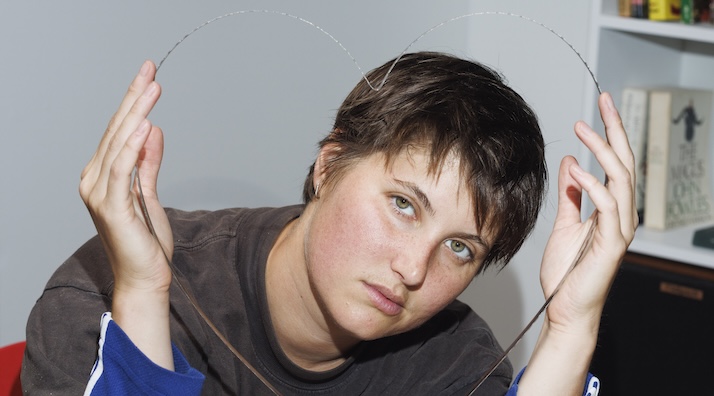
Photo by Dallas Houston
Lorg’s debut solo album, I Fell For Fantasy, unravels the complicated entanglement that the heart and the mind can become wrapped up in — where longing, uncertainty, heartbreak and acceptance exist all at once. Through dream-like guitars, inviting bass, hazy electronic textures and vulnerable vocals, Lorg creates a soundscape that feels like getting lost inside your own memories. Each track approaches life and love from a different angle, letting you confront a new emotion with every song. Rather than simply relaying their experiences, Lorg’ I Fell For Fantasy unfolds with a storybook level of immersion.
Lorg marks a new chapter for L Morgan, vocalist and co-creator of the indie-pop duo SALES. With this solo project, Lorg moves into more atmospheric territory, blending soft pop and indie-folk with the glitter of electric additions to result in a sound that feels distinct and individual from their work with SALES. The project first emerged with “Brandy” in September 2024 and now expands into the full-length solo album, I Fell For Fantasy. Made with producer Adam McDaniel, whose credits include Angel Olsen and Animal Collective, the record was recorded between Asheville’s Drop of Sun Studios and Lorg’s home setup before their move to New York City, snapshotting a period of creative and personal transition.
The album’s songwriting process ignited with “Cowboy Songs” — the last single before the full record drop — as Lorg has expressed. That sense of breakthrough feels crucial to the album as a whole, making it the only song that could’ve been the opener for this record. From there, we move through previously released singles “Brandy,” “Marathonia” and “Crossroads,” each helping establish the emotional language of the album.
“Crossroads” is particularly effective in capturing the mental gymnastics you go through when doubt creeps into your mind, whether it surrounds a relationship — is it right to stay or leave? — or any life decision. The thump of the drums of echoey rhythm of the guitar push forth Lorg’s vocals as they lyricize the internal back-and-forth. It personifies the drift of not being able to land on a path choice wholeheartedly. “If I lay here / At a crossroads / Until next year / Til the frost blows” becomes the perfect encapsulation of that desire to stop moving long enough for the decision to somehow make itself.
“How Many Days” deepens that emotional limbo. The song feels like you’re spinning on a record, mirroring the effect of waiting out a breakup that still has a hold on you. Every sonic element molds together to form a smooth wave of sound that flows into your ears: seamless blends of firm drum pad hits, delicate guitar, warm bass and wispy vocal runs. The atmosphere envelopes you in the dragging, emotionally draining process of wanting to get over someone and the eventual apathetic acceptance of distrust that emerges after the breakup.
That isolation is taken further with “In The Cold.” Droning, levelling ambiance surrounds piercing falsettos repeating, “In the cold,” while the emotional core of the track arrives in the devastating contradiction, “I want it to be nothing / But I fell for you.” It captures the push and pull between logic and feeling: knowing you shouldn’t be with this person, or maybe anyone, and yet your heart betrays your mind. There’s, oddly enough, a warm comfort that derives from the isolating musicality. It settles you into the emotion, rather than amplifies it, allowing you the space to feel the energy that layers the track. Then, the abrupt fade-out closes the song, heightening its effect for just a split second before the silence soothes you once again.
“Moody Jam” leads into “Hall of Your Heart,” a fresh utilization of autotune that gives the vocals an almost glitchy effect among the warped, memory-esque soundscape. It becomes the self-aware, realistic reflection between “Moody Jam” and “Life Of A Dream,” looking back on the relationship and seeing the emotional issues felt both in and out of the relationship. “There’s nowhere to stand / In this hall of your heart / All these phantoms in the way / In this hall of your heart” turns the relationship into a place that is impossible to maneuver. The playfully intimate voicemail inclusion — “Dude, Lorg, where the fuck are you?” — only makes the metaphor more affecting. It holds the ability to mirror a familiar voice calling you from the outside as you get lost trying to navigate through someone else’s heart, or even your own.
Following with starry twinkles of electronic detailing alongside light, airy guitar plucks, “Life Of A Dream” maintains the album’s dreamlike atmosphere while allowing its emotional weight to float rather than sink. Then comes “Epilogue,” which, despite being only 38 seconds, makes a striking impression. Its vocal filter and subtle distortion of the backing production make for such an engaging soundscape. It’s soft, yet textured, creating a gentle release as well — the comedown to this mind-warping journey of heartache and uncertainty. It feels like the first deep breath after spending so long holding one.
That makes the closing song, “So I Put It In A Song,” feel so powerfully rewarding. The track swells so beautifully; the guitars and synth additions create a forgiving dreaminess, making the song feel so big, but still so intimate. The musical air is hazy, like watching someone fade from view: “So I put it in a song / To never forget my love / My lover who’s on the run / I run but I can’t keep up.” There’s a shimmer that rains down over “So I Put It In A Song,” evoking a wistful, yet hopeful energy: an acceptance of the past and using it to create a future in a way that honors the experience and the effect it had.
Ending with the voice recording, “Did I make it there yet?” — Lorg asking in the studio after a long vocal day — was such a sweet musical decision that truly truly wraps the album up with a perfect bow. It encapsulates the softness of wanting to make it, to get where you want to be within yourself and your happiness, and also the quiet strength it takes to ask that question in the first place.
Ultimately, I Fell For Fantasy succeeds because Lorg doesn’t pretend that moving on is a clean or linear process. Its characters — whether they are lovers, doubts, memories or versions of the self — blur together inside a dreamy sonic world where uncertainty is given permission to linger.
Listen to I Fell For Fantasy below:
![chandol's Mercurial Mini Tour Documentary Captures His Most Authentic Self [Premiere + Q&A]](https://s3-us-west-2.amazonaws.com/onestowatch-v2/2026__chandol_north_america_tour__film-_chandol__n_a_tour_2026-220-positive_@connortherealgaskey_-1790299950.jpeg)