Hans Williams Found His Musical Identity In New Orleans [Q&A]
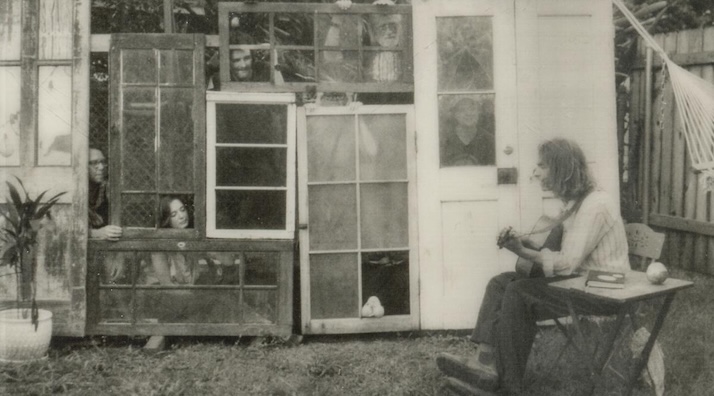
Photo by CJ Harvey
“I hate talking about anything related to my project,” said New Orleans-based singer-songwriter Hans Williams after several prolonged minutes of pro-wrestling and NOLA-centric jibber jabber in the early bits of our recent Zoom interview. “So, this is great. We’ve killed a bunch of time already.” At this time, he was in Nashville, supporting his girlfriend and fellow creative Olivia Barnes as she participated in a slew of writing sessions in town, as well as prepping for a show of his own coming up this December.
Williams, unfortunately, could not remain sheepish for much longer, as this writer caught his opening act slot for Chance Peña at NYC’s Webster Hall this past summer, and walked away from the gig with a number of burning questions. Most were in relation to his song “Marie’s Moon,” a meticulously crafted and gut-wrenching tune about and for his grandmother, who is fighting an ongoing journey with dementia. Performed during the solo acoustic set, which Williams bodied, he prefaced the song with just a sliver of her story, and, for just a few fleeting minutes, the room was frozen with not a cell phone in sight: “Can you tell me what’s my name? Or do you only remember shame in your life? Are you watching the moon again?”
The tune is included as the final track, and therefore emotional climax, of Williams’ new album, Songs for the Neighbors, out now. We spoke about the song itself, and its emotional framing, in depth, while also covering a number of other distinguished selections for the project, such as “Harding Road,” “The Door,” and “Never Too Quiet.” The latter pair adhere to a particular systemic structure, leading to questions regarding his standard songwriting practices and, through that window, into his mindset amid the development of melodies, lyrics, and arrangements.
“Harding Road” acts as, perhaps, the most evident example of Williams’ musical adaptation to New Orleans, having moved there from Norwich, Vermont to attend Tulane University. “Where I grew up, there’s so much space,” he said, when asked to elaborate on previous statements regarding feelings of isolation. “I didn't have much to write about there.” Once down south, the feel and sounds and soul of the music engulfed him, and his sonic aesthetic now reflects that shift.
Gorgeous mid-album track “Where It Goes” sees the musical framing reversed, with Williams slipping back into his northeast folky tendencies. The dual lyrical perspective of the tune lends itself to a female contribution, though Williams had not yet explored that aspect. Instead, he is joined on it, modestly, by trusted collaborator Phin Choukas who, along with Barnes and mutual friend Lyla George, will be accompanying him on the road in 2027. Williams hyped all three, and a plethora of other NOLA-based acts, when asked for his OnesToWatch, reinforcing his allegiance to his artistic community.
OnesToWatch: To start, who are your OnesToWatch right now?
Hans Williams: I’ve been digging into a lot of Dermot Henry recently. He's got such a tender way of communicating, and I tend to prefer piano heavy music these days. In that same vein, Jacob Alon. I feel like I was put on to him through Dermot's work. Again, a super tender vocalist and communicator, and clearly has a really big heart.
Let me put on some New Orleans folks here. Noa Jamir are local to New Orleans. They have, again, another very soft but powerful way of communicating. Their voice, live especially, just cuts through. They have this falsetto that's very breathy. The mic is always cranked up, and it's very saucey and breathy, but it gets loud too at some points. Is it okay if I do a few more?
However many you want to give.
It’s so tough. There's so many. I'd say Maddie Kirgo as well. She's another New Orleans artist. It's something, again, you just have to see live, but her vocal is so present when you hear her. It's so light and airy. Almost like the way I hear Dolly Parton in a similar way, but not quite as country forward. There's not that twang, it’s more like alternative music with some Americana in there. They're working on a new project that I think has gotten finished up recently.
And then I'll put on my friend Phin Choukas. Him and I produced this record together, but he's really the facilitator among myself and the band. He's been releasing under his own project for the last few years, and has recently been really digging into this more psychedelic side of folk music. And he's going about figuring out his band and exploring in his recording process. He tends to overdub more stuff, but we made a studio about a year ago, and he's been using a lot more live drums recently and starting to dig into more simultaneous live recording.
I also live with my girlfriend Olivia Barnes, and Lyla George as well, who you might be familiar with through my project. Olivia's first EP comes out on Friday actually, and my favorite song of hers, “Human Nature”, is the title track. A handful of these songs on my project, and on her project, were inspired by each other. So, it's both really sweet and cute to listen to, but also painful in a nice way. Lyla is working on a bunch of new music, but came out with her first album towards the end of last year. I guess we haven't announced the support yet, but Olivia, Phin, and Lyla are all gonna open up for me on the east coast run, just because it'll be fun to tour with friends and they also are a big part of this project too. We're constantly pushing each other in a way, so it just felt right to have them come out with us.
Alright, I'm starting with a big one here. “Marie’s Moon.” Do you feel like you need to preface it with the story you tell before you play it live?
I don't think I need to, but it's a better listen knowing that context. But yeah, sometimes it's too much information for people. Although, it doesn't make sense in every setting. At a festival, it might not make sense. For example, I'm going home and I'm gonna play this fundraiser at Lebanon Opera House, and my grandmother knows so many of the people that will be there. She's not gonna be there herself, but it would be too personal of a story to tell. And then, I'm also gonna play it at the care facility that she's at over Christmas. I definitely won't mention the story then, because the whole point of the song is to get around actually talking about it with her. Even with that story, she didn't even tell my mom. My mom had learned through other people that that happened. So, it’s something that she just doesn't want to talk about.
If you were on the outside looking in, listening to that song at a Chance Peña show let’s say, how do you think you would interpret it?
Without hearing any of the context?
Yeah.
[Long pause] I think I would pick up that it's about someone asking or hoping for someone else to be forgiven. I don't think I would know that it's about someone's abortion, necessarily, but I would get the feeling of looking for, or hoping, someone finds some relief. It's kind of hard for me to remove myself from it knowing what the song is about. I tend to feel like, even with some of the best written songs, what I walk away with is that it's always gonna be taken in through the context of your own experience. It depends on what you're going through at that very moment.
At least for that run, my favorite part of the whole show was getting to that song. The story's a little painstaking, but it's worth telling. And that audience was kind enough to listen every night. It's also the last song on the on the set too, so it's a really nice moment for me to just sit back and feel. To be deeply connected with the thing that I'm doing, which is the whole point of playing, but not always the case when, for some songs, you're not as closely connected to. So yeah, it felt like each night, that was when there was the least barrier between us.
A lot of your choruses, like “The Door” and “Never Too Quiet,” tend to be rather sparse lyrically where the verses paint the pictures and expand on the narratives. How did that method become your standard practice of songwriting?
It's really interesting. I've never noticed that, but it's so right. I think it's so much easier to get your point across with fewer words, generally. Not always, but it's easier to be clear when you know when it's something that's concise. Knowing that now, I’d be curious to play around with that and try to just not do that. But yeah, I'm not sure. I really am not thinking too hard when I'm writing. “The Door,” I hadn't finished writing the day we went to record it, and that's the same for a few of the songs. As we were recording it and getting the arrangement down, I was getting my words down and then, halfway through the day, maybe we try to record it and see how it feels. Most of the time, I'm just vocalizing whatever feels right, and then obviously, sometimes, it doesn't make sense and sometimes it does. It's not always even worth it, because people are gonna find their own meaning either way. The only thing that matters is if it makes you feel something. And that feeling something is partly dependent on the lyrics, and for me, mostly dependent on the way I say it, the melody, and all the arrangement around it. All these things that feel intangible. So, that one I definitely sat with, and, throughout the day, was asking Phin if it made sense. Consistently, his answer was “We’ll make sense out of it after the fact.” I hadn't recorded this much music in a couple years, so part of this project was good practice in not treating it too preciously, seeing what you can make, and ACTUALLY finishing it. Because no one will hear it if you don't.
Is there an example of a song that the meaning changed based on how you performed it vocally?
Almost every song I write, its meaning is derived from that, and from the melody. And usually the lyrics are secondary, or the last thing I figure out. For example, on “Easy Eyed,” the live take that we did, I was saying mostly the same things, but some things literally didn't make any sense. And there may be some words that weren't actually words, but the take itself felt really good. It was all recorded in the same room. So, my vocal take from the original take is in the drum mics. It's in the other mics that are in the room, which is awesome, but also poses a problem if you go to change lyrics. What I did is I sat with that take for that night, but there are moments where I felt like I could be clearer lyrically. So, I did an overdub of most of the vocal take, and I just sang similar consonants and vowels, but changed the words a little bit so that everything still lines up with the original vocal take. But, the words are more articulate, and I feel like it worked. That's generally what I do writing every song. We usually don't record it before we know what we're saying, but that one was just so spontaneous, and the night before, I had come up with a little riff and brought it to the band that day. That one take, all of us were like, “Yeah, that's the song right there.” So, to answer your question, every song is informed by that. And I'll almost always prioritize that feeling and that melody over the lyrics. My interpretation of it is through that melody and oftentimes the phrasing, and that's how I build my understanding of the song. The lyrics are almost a reaction to that.
Had you ever considered a female pairing for “Where It Goes” considering you explore dual perspectives in it?
No, I hadn't. I'm curious to try some of these songs, especially when we're on tour. Phin is singing on “Where It Goes” already, and I’d try some of them with Lyla and Olivia as well. But no, I really didn't consider doing any collaborations on this project. I kind of wanted to see where we could get with myself and the band. and then leave the songs open to, hopefully, having a life outside of this initial project, But, that's a really good idea.
In your Luna Collective interview, you talked about the isolation of living up north until you were old enough to get a driver's license, and then you had more freedom to go as you please. Were the themes of isolation and personal reflectiveness the things you felt most comfortable writing about until you were able to get out and go to New Orleans, where you were able to spread your wings more?
Yeah! Generally, that's what I was writing about until I left Vermont. Since coming to New Orleans, a lot of what I've written about has been derived from this one experience I had right when I moved here. There are still themes of isolation, but I don't live in a rural area anymore. Where I grew up in in Vermont, there so much space. I didn't have much to write about there. That was really the most present theme throughout growing up there until I started my adult life and moved away.
When you moved down south, how did that change your vision of your own musical aesthetic?
When I moved originally, I went to Tulane University, and Tulane is pretty isolated from the city itself. So, I don't think it changed immediately. Once I really started digging into the scene in New Orleans during my junior year, I met everyone in the band, and we started playing together. It reinforced some of the other music I grew up on. It opened me up to a lot of other music, and seeing live music every night is the most inspiring thing you can do. I didn't really have that in Vermont, since there wasn't much of a live scene. I had an identity as a person, and I had this introspective writing, and I've still held on to that, but I hadn't really formed a musical identity yet. I grew up on a lot of funk and folk music. So, it just made me realize I wanna make music that makes you move. I could be there for another eighty years, and I would still be slowly picking things up. And to be honest, I say the city, but it's mostly my band members that have influenced me the most. Receiving all of their musical experience as well.
For “Harding Road,” which is very much derived from that area and that sound, what are your favorite musical elements?
I love how there's just this high-strung guitar going throughout the whole thing. It pushes it along, really light and percussive. I love the lift of the tambourine and all the percussion that Isaac laid down on it. It allows for a lot of syncopation, and you sit back in the groove. And then the horns, played by Oliver Tuttle. He's plays trombone for a bunch of folks in New Orleans. I sent him that song, and, within an afternoon, he sent it back with a whole horn arrangement on it. All his own trombone playing. That's probably my favorite part of the song. Same thing with “The Door.” Phin and I wanted to have horns somewhere else in the project, so it didn't feel entirely out of place.
Listen to 'Songs for the Neighbors' below: